

Inside America’s fight for lead safe housing: ‘Why do our children have to be used as lead detectors?’

Amplifying frontline voices from A2 member groups.
Darrick Wade lost his son in 2007. Demetrius, who was 24, had been lead poisoned as a child and had lived with chronic health problems since childhood.
The family had been living in Lakeview Terrace, a 1930s-era public housing complex in Cleveland, when they discovered Demetrius, then nine, had elevated levels of lead in his blood. At the time, Wade had been reading up on housing safety guidelines, as he had been looking at starting a construction company.
“Once I learned about the different illnesses and the environment, I said, 'Let me take a chance to get my son tested. His lead levels came back high,” says Wade, who is on the board of directors of Cleveland Lead Advocates for Safe Housing (CLASH), an A2 member.
From 1996 onwards, Demetrius became “sicker and sicker”, Wade says. “I watched the progression of his anger, him not being able to use his cognitive skills as he declined in learning.”
Demetrius’s physical health suffered. “Age 12, diabetes; 14, he had liver disease, 15, kidney disease, 17, an enlarged heart. By the time he was 19, he had problems with his esophagus. Ultimately, my son died September 15, 2007,” Wade says. “The examiner could not determine the cause of death. It could have been any of those illnesses,” Wade says. Several diseases have been linked to lead, including chronic kidney disease and heart disease.
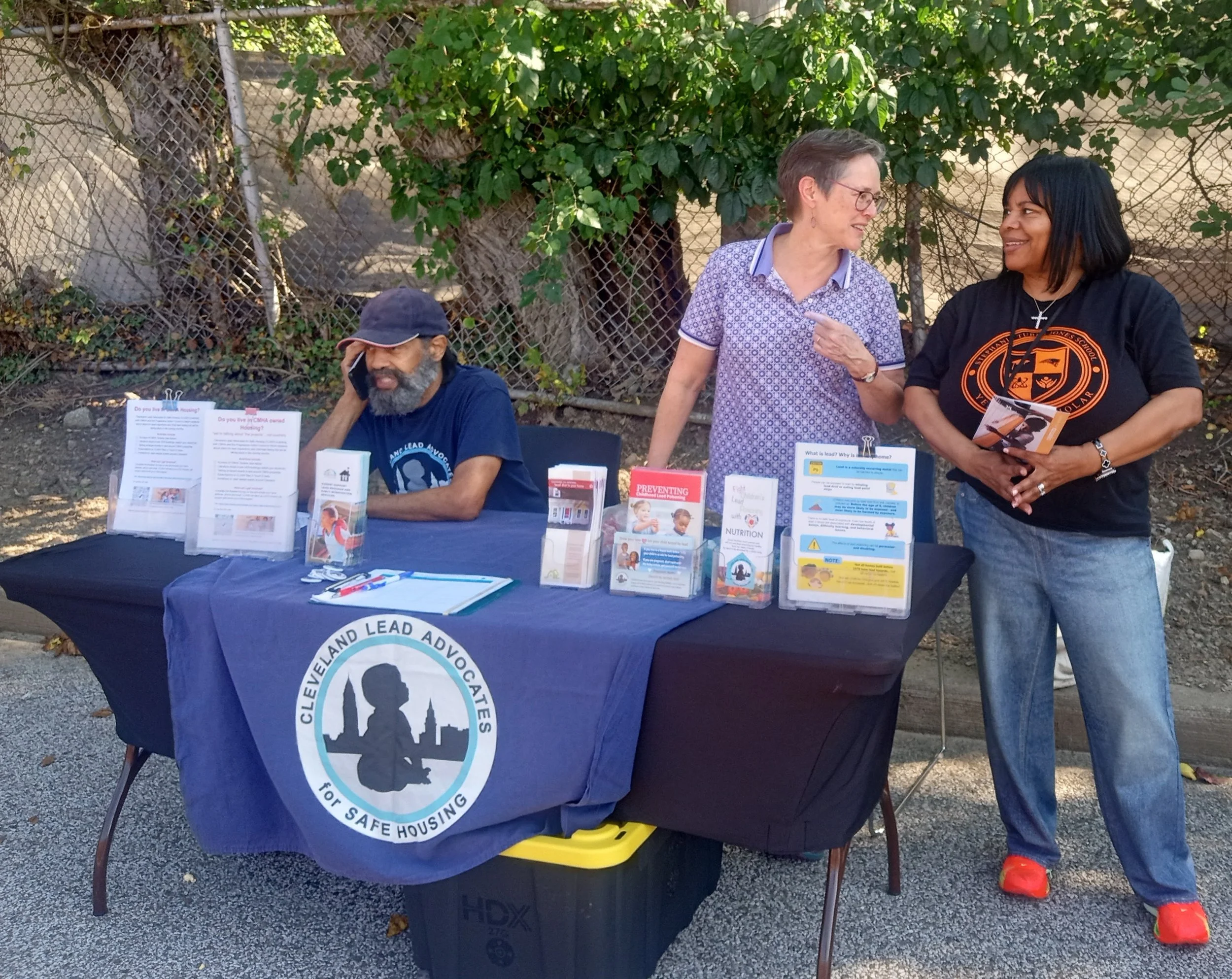
CLASH members at a stall to raise awareness about lead hazards. Photo: courtesy of CLASH.
Lead poisoning remains a threat to children in the United States. Although significant strides have been made in the reduction of blood lead levels since the 1970s, up to 3.6 million families with children under six still live in homes with potential lead exposure hazards. Children in Cleveland are about four times more likely to have elevated blood lead levels compared to the national average, primarily due to the age of the city’s housing stock. Young children are particularly vulnerable as lead adversely affects development, and as they often put their hands and other objects in their mouths.
Queen Zakia Shabazz’s son, too, was lead poisoned. Tested at 18 months during a well-baby visit, Shabazz says her son, now 31 and currently incarcerated, still suffers the effects today. “Impulsivity challenges, linked to criminality … A lot of it is not recognized until they start school, when children are often affected by attention deficit disorder,” she says. Shabazz, the founder of United Parents Against Lead & Other Environmental Hazards (UPAL), an A2 member, believes that lead poisoning should be considered as a factor in criminalization.
When her son was tested, Shabazz was living in a rental home in Richmond with lead-based paint. It was also near an alley with contaminated soil, she adds. The family moved away after her son, Zaki Abdullah, was tested: she says his lead blood levels showed 30 micrograms per deciliter. In 2026, if a child's blood test reveals a level of 3.5 or above, the CDC recommends public health interventions to identify and eliminate environmental sources of lead exposure. Shabazz asks: “Why do our children have to be used as lead detectors?”
The UPAL founder, who has worked with parents of lead-poisoned children across the country, says housing protections for tenants against lead vary from state to state. “We need a lead safe housing registry,” she stresses. Her organization has engaged in local efforts to keep families safe from the toxin: in 2004, UPAL received a $2 million grant to conduct lead testing and remediation of homes in high-risk areas in and around Richmond. “We tested 100 and remediated 80 – covering soil if it was bad, painting baseboards, installing new windows and doors,” she says.
There is no safe level of lead exposure. It is connected to developmental delays, learning disabilities, and behavioral problems in children and raises the risk of high blood pressure, fertility issues, and cognitive decline in adults. Children from low-income households and those who live in housing built before 1978 – the year lead-based house paint was banned – are at greatest risk. Lead paint and contaminated dust in older homes remain the nation’s main source of lead poisoning, as well as water from lead pipes and topsoil near roads, contaminated by decades of leaded gasoline pollution. While at very high levels, chelation therapy to remove lead from the blood is sometimes an option, even this cannot reverse the damage already done.

National Center for Healthy Housing staff and healthy housing allies at the Find It, Fix It, Fund It meeting in Washington, DC, August 4, 2016. Photo: courtesy of UPAL.
But with much of the nation’s housing stock pre-dating 1978, the presence of paint is not the sole determinant of whether a building may be dangerous. Whether a home is an active hazard, rather than just a potential lead risk, often depends on its maintenance.
Working as a contractor in recent years, Wade visited houses in Cleveland’s suburbs and noticed their walls were often papered – and began to see a pattern that partly explained why poorer children were at higher risk from lead poisoning. “I went into the suburbs, and all of the people who were well-to-do, educated – their homes were wallpapered for insulation,” he recalls, noting the impact of redlining, which segregated neighborhoods. “Public housing homes were never insulated with wallpaper. It was just lead paint on the interior and exterior … [Many] kids in low-income housing were left cognitively disadvantaged. It really bothered me.”
The legacies of segregation and redlining continue to drive unequal health outcomes. Socioeconomic and housing inequalities mean that, on average, Black children in the United States still face significantly higher risks of lead poisoning.
Spencer Wells, CLASH’s communications manager, says that children in rental homes are often at a higher risk of lead exposure than those living in homes owned by their family, because homeowners tend to do a better job at maintenance than landlords. While many homes in Cleveland have a potential lead risk, Wells explained, the risk becomes a hazard when a property is neglected and falls into disrepair. Referring to the neighborhoods that were most at risk, Wells says, “It wasn't even just all the rentals. It was the rentals that had been where families had been redlined from having housing opportunities outside that area.”
Wells says that as previously predominantly white suburbs of Cleveland became more diverse in recent decades, screening showed that more neighborhoods were home to children with elevated lead blood levels. Rather than this trend being driven primarily by the movement of children who had previously been exposed to lead, he believes it is because the housing in new neighborhoods has deteriorated, exposing children to new lead sources: “There’s now more low-income housing.”
“Since redlining has changed … the locations of children with elevated blood lead levels have changed – because the low-income housing has spread out of those defined redlined areas,” he notes, with higher concentrations in areas “where housing is deteriorating.”
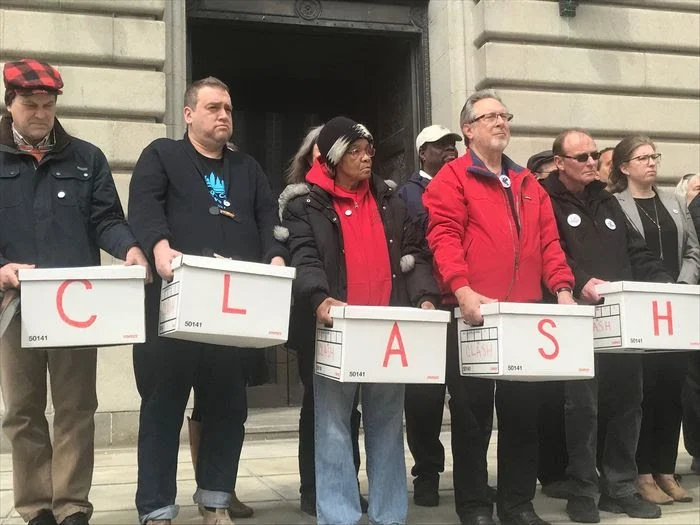
Members of Cleveland Lead Advocates for Safe Housing (CLASH) delivered more than 10,000 signatures to City Hall today in order to get lead poisoning prevention legislation in front of City Council.
Regulation is key to protecting more children from the lifelong effects of lead poisoning. In 2019, CLASH helped develop and force a vote on legislation that stipulates that pre-1978 rental units in Cleveland must regularly obtain a certificate to prove they are safe from lead hazards. Spencers says that putting the law into practice has been a slow process, amid the pandemic and problems caused by the lack of a rental register, and enforcement has proved to be another stumbling block. But the city has recently introduced fines for those renting without an up-to-date certificate. “Now, we’re starting to have compliance,” Spencer says.
The CLASH coalition’s three goals are to implement the certificate law, increase childhood lead testing, and build a base of community awareness. While the coalition primarily focuses on policy and advocacy, member organizations, like the Black Child Development Institute Ohio, partner with public health entities to bring lead screening to families.
“Lead safe [housing] is the goal, not lead free,” explains Wells, as demolishing all pre-1978 housing is not feasible, but changes to a property – like replacing the doors and windows and putting up siding – can remove hazards, as long as the property is then well maintained.
Shabazz identifies political will, funding, and public awareness as the chief barriers to eradicating lead poisoning. “We need lead awareness campaigns around the country – not just waiting until there's a crisis like Flint. Every few years there's a big lead poisoning [story], then it kind of subsides and dies down … But those children are still poisoned, those families are still living in those conditions, although it's not reported in the news anymore.”
Describing lead as a “silent killer”, Shabazz stresses: “Lead is a hidden enemy. Don't let your child be the lead detector – find the lead before your child does.”